Monday, November 2, 2015

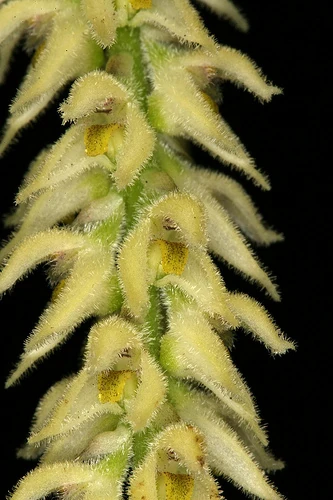
Bulbophyllum odora!ssimum

Bulb. odoratissimum
Scientific Classification
Kingdom: Plantae
Division: Magnoliophyta
Class: Liliopsida
Order: Asparagales
Family:Orchidaceae
Subfamily: Epidendroideae
Tribe: Podochilaeae
SubTribe: Bulbophyllinae
Genus: Bulbophyllum
Species: Bulb. odoratissimum
Alliance:
Binomial name
Bulbophyllum odoratissimum
[Sm.]Lindley 1828

Rhizome creeping or straggling, 2-4 mm in diam., branched, covered with membranous tubular sheaths, rooting from base of pseudobulbs, roots spreading. Pseudobulbs 4-8 cm apart from each other, subcylindric, 2.5-5 cm, 3-6(-9) mm in diam., with a terminal leaf. Leaf subsessile; blade oblong, 4-13.5 × 0.8-2.6 cm, leathery, apex obtuse and slightly emarginate. Scapes 1 or 2, yellowish green, from base of pseudobulb, erect, to 14 cm; raceme often nodding, shortened, umbel-like, densely more than 10-flowered; peduncle 1-3 mm in diam., with 3 or 4 tubular sheaths 8-10 mm; floral bracts whitish, ovate-lanceolate, 7-10 mm, membranous, apex acuminate. Pedicel and ovary shorter than floral bracts. Flowers slightly fragrant; sepals and petals white, later turning into orange in apical half; lip tangerine. Sepals free, thickly textured; dorsal sepal ovate or ovate-lanceolate, 3-7 × ca. 1.5 mm; lateral sepals lanceolate, 4-14 × ca. 2 mm, margins incurved from middle to apex and tubular or subulate in shape, apex obtuse or subacute. Petals subovate or elliptic, 1-2 × 1-1.5 mm, thinly textured, apex subobtuse; lip slightly recurved, ligulate, fleshy, margins with white glandular hairs, adaxially with 2 densely minutely glandular-hairy ridges, base with a short claw attached to end of column foot, apex obtuse. Column ca. 1 mm, stout; stelidia ca. 0.2 mm; foot ca. 1 mm, with free part ca. 0.5 mm; anther cap nearly subglobose or cordate, finely papillate. Fl. Apr-Aug. 2n = 38.
Tree trunks in mixed forests, rocks along valleys; 200-2400 m. Fujian, Guangdong, Guangxi, S Sichuan, SE Xizang, W to SE Yunnan [Bhutan, NE India, Laos, Myanmar, Nepal, Thailand, Vietnam].

CITIES category : Appendix II

References 
1. Ref 1

Sunday, November 1, 2015

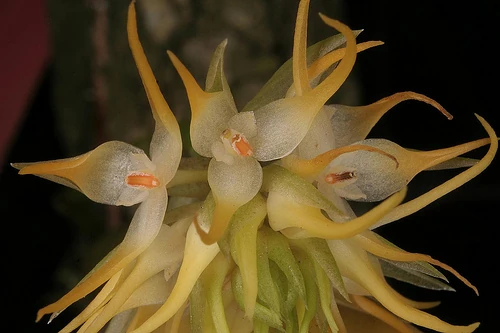
Bulbophyllum muscicola

Bulbophyllum muscicola
Scientific classification
Kingdom:Plantae
(unranked):Angiosperms
(unranked):Monocots
Order:Asparagales
Family:Orchidaceae
Subfamily:Epidendroideae
Genus:Bulbophyllum
Species:B. muscicola
Binomial name
Bulbophyllum muscicola
Rchb.f. [1]


Common Name The Moss-Growing Bulbophyllum
Flower Size 5/8" [1.5 cm]
Found at elevations up to 1500 meters as a miniature sized, warm to cool growing epiphyte occuring in the eastern Himalayas, Assam and Nepal where it has fat, flattened, ovate psuedobulbs with a single, elliptical leaf that is acute at the base and obtuse at the apex and blooms in the fall on a slender, basal 2 3/8" [6 cm] long inflorescence with an apical umbel of 3 to 10 flowers held below or just above the leaf.
Synonyms Bulbophyllum hookeri [Duthie]J.J.Sm. 1912; Bulbophyllum wallichii (Lindl.) Merr. & F.P.Metcalf 1945; Cirrhopetalum hookeri Duthie 1902; Cirrhopetalum wallichii Lindl. 1830
References W3 TropicosKew Monocot list IPNI ; The Orchids of Sikkim-Himalaya Part 1 King & Pantling 1898 as Cirrhopetalum wallichii drawing fide; The Orchids of North-Western Himalaya Vol IX Part II Duthie 1906 as Cirrhopetalum hookeri drawing ok; Die Orchideen Schlechter 1915 as Cirrhopetalum hookeri; Notes on Cirrhopetalum Seidenfaden 1973 as B hookeri drawing good; Orchids of Northwest Himalaya Deva & Naithani 1986 as B hookeri drawing fide; Indian Orchids Guide to Identification and Culture Vol 2 Pradhan 1979 as B hookeri drawing fide; Orchid Digest Vol 44 No 4 1980 as Cirrhopetalum wallichii photo fide; Die Orchideen Band 3 Sonderabdruck aus Schlechter Brieger, Maatsch and Senghas # 40 Bulbophyllinae 1983 as Cirrhopetalum wallichii photo fide; Orchids of Kumaun Himalayas Pangtey, Samant and Rawat 1991 as B hookeri; Bulbophyllums and Their Allies Seigerist 2001; Orchids of Bhutan Pearce & Cribb 2002; A field Guide to the Wild Orchids of Thailand Vaddhanaphuti 2005 as Cirrhopetalum wallichii photo hmm;


CITIES category : Appendix II

References 
1. Ref 1

Bulbophyllum moniliforme

Bulbophyllum moniliforme
Scientific classification
Kingdom:Plantae
(unranked):Angiosperms
(unranked):Monocots
Order:Asparagales
Family:Orchidaceae
Subfamily:Epidendroideae
Genus:Bulbophyllum
Species:Bulbophyllum moniliforme


Common Name The Necklace-Like Bulbophyllum
Flower Size 3/16" [1 mm]
Found in Laos, Cambodia, Vietnam, India, Myanmar and Thailand as a mini-miniature sized, hot to warm growing epiphyte or occasional lithophyte at elevations around 20 to 800 meters with very small, wrinkled, round, glossy green pseudobulbs in clusters with a single, apical, tiny, deciduous, erect, fleshy, oblong-elliptic, acute, apiculate, sessile base leaf that blooms in the fall and winter after leaf-fall on an erect to suberect, basal, laterally, 3/4" [2 cm] long, single flowered inflorescence holding the flowers above the leaf.
One of the smallest sized orchids of the Bulbophyllum.
It has come to my attention that for many years I have had this species and B minutissima confused and have said they are synomonous, nothing could be farther from the truth as the photos supplied attest. Kew along with many other major orchid references have these 2 as the same species please take note that they are indeed separate. One major difference other than the flower is the fact that this one blooms after the leaf has fallen, B minutissima always keeps its leaf when blooming.
Synonyms Dendrobium nummulifolium R.King 1879; Phyllorchis moniliformis (Parish & Rchb. f.) Kuntze 1891
References W3 TropicosKew Monocot list as Synonym of B minutissima not!, IPNI ; The Orchids of Burma Grant 1895/95; The Orchids of Thailand Seidenfaden & Smitinand 1959 drawing fide; AOS Bulletin Vol 35 No 4 1966; Orchid Genera in Thailand Vol VIII Bulbophyllum Thou. Seidenfaden 1979 drawing good; Die Orchideen Band 3 Sonderabdruck aus Schlechter Brieger, Maatsch and Senghas # 40 Bulbophyllinae 1983 drawing; Orchids Of India II Biodiversity & Status of Bulbophyllum Thou Augustine & Kumar 2001; A Field Guide to the Wild Orchids of Thailand Vaddhanaphuti 2001 photo fide; Bulbophyllum and Their Allies Siegerist 2001; A field Guide to the Wild Orchids of Thailand Vaddhanaphuti 2005 photo fide; Native Orchids of Australia Jones 2006 as Oncophyllum minutissimum; The Orchids of India A Glimpse Misra 2007 drawing ok; Bulbophyllum: the incomplete Guide From A to why? Bill Thoms 2009 photo fide; A Compendium of Miniature Orchid Species Gerritsen and Parsons 2013 photo fide


CITIES category : Appendix II

References 

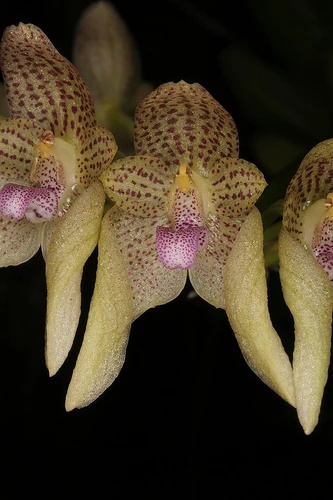
Bulbophyllum leopardinum

Taxonomy 

KingdomPhylumClassOrderFamily
PlantaeTracheophytaLiliopsidaOrchidalesOrchidaceae

Scientific Name:Bulbophyllum leopardinum
Species Authority:(Wall.) Lindl. ex Wall.
Common Name(s):
EnglishLeopard Spotted Bulbophyllum
Synonym(s):Sarcopodium leopardinum (Wall.) Lindl. & Paxton

Assessment Information

Red List Category & Criteria:Least Concern ver 3.1
Year Published:2013
Date Assessed:2011-01-06
Assessor(s):Cockel, C.
Reviewer(s):Rankou, H.
Justification:
Few representative specimens were available for range analysis, but neither the extent of occurrence (EOO) or area of occupancy (AOO) is estimated to be below the threshold for a threatened category. There are numerous threats to plants and specifically orchids in this region such as over-collecting for medicinal use and the ongoing threats of logging, expanding human populations and conversion of habitat to agriculture. At present there is not enough data to suggest Bulbophyllum leopardinum is in decline or under immediate threat. However, contemporary collections or observations are needed to confirm the species is still extant and better data on orchid harvesting for this region is urgently needed. At present, due to the large range a rating of Least Concern is advised.

Geographic Range 

Range Description:The species occurs in Nepal (2,000-3,200 m (Rajbhandari and Bhattarai 2001)), China (S Yunnan), Myanmar, Viet Nam, Lao PDR (Phongsali), Thailand, Bhutan (Punakha, East side of Dochu Lake, between Tashi Choling and Kyebaka; and Tashingang, near Tashi Yangtsi), India (Sikkim, Lachen valley, Tendong 1,400-2,300 m (Pearce and Cribb 2002); Arunchal Pradesh, 900-1,800 m (Hegde 1984)).
Countries occurrence:
Native:
Bhutan; China; India; Lao People's Democratic Republic; Myanmar; Nepal; Thailand; Viet Nam
Lower elevation limit (metres):900
Upper elevation limit (metres):3200
Range Map:Click here to open the map viewer and explore range.

Population

Population:In Nepal, the species is common in forest above Godawani Botanic Garden, and is seen on the north-facing forest at Daman at 2,000 m (White and Sharma 2000).
Current Population Trend:Decreasing
Additional data:

Habitat and Ecology

Habitat and Ecology:The leaves of this species are deep green. The flowers are pale green and spotted red, simulating the skin colour of a leopard. The species forms large colonies. The flowers have a very offensive smell and attract carrion flies. The species is said to favour partial shade of ever-green broad-leaved sub-tropical forest 1,500-2,000 m (Raskoti 2009).
Systems:Terrestrial

Use and Trade 

Use and Trade:This species is used for compost, cattle bedding, and human and animal consumption.

Threats 

Major Threat(s):The species is threatened by over-exploitation for ornamental plants (Raskoti 2009). Illegal and damaging collection of wild orchids for medicinal purposes is also said to be a problem in Nepal, particularly in Makwanpur district, from where they are exported to neighbouring countries for use as compost, cattle bedding and feed. The trade in orchids forms the basis of livelihoods for some people in Nepal and the increasing scarcity of the plants is a cause for concern for such people (Acharya 2009). This particular species is said to be easily cultivated on tree-fern blocks (Hegde 1984), so is likely to be attractive to collectors. The vegetation of the region is under significant threat from a combination of logging, dam-building, agriculture and human population increases (P. Cribb pers. comm. Dec. 2010). In Lao PDR, although relatively untouched botanically compared with its neighbours, orchids are collected on a 'massive scale' by the local population for sale in Thailand and Viet Nam. Some orchids, principally dried Dendrobium sp. are collected for the Chinese medicinal market. CITES enforcement is virtually non-existent in Lao PDR (Schuiteman et al. 2008).

Conservation Actions 

Conservation Actions:One specimen was collected from within the Shivpuri National Park in Nepal, not far from the capital Kathmandu. No ex situ collections are known to have been made. Further studies on the rates of wild orchid collections in this region and the impact this has on this species is needed.

Citation:Cockel, C. 2013. Bulbophyllum leopardinum. The IUCN Red List of Threatened Species 2013: e.T44392371A44532711. http://dx.doi.org/10.2305/IUCN.UK.2013-1.RLTS.T44392371A44532711.en . Downloaded on 01 November 2015.


CITIES Category : Appendix II

References
1. Ref 1
2.Ref 2

Bulbophyllum hirtum


Bulbophyllum hirtum is a species of Bulbophyllum found in Asia.


Plant blooms in the summer with several 6 mm wide flowers. Flowers are fragrant with the scent of cinnamon.

Bulb hirtum
Scientific Classification
Kingdom: Plantae
Division: Magnoliophyta
Class: Liliopsida
Order: Asparagales
Family:Orchidaceae
Subfamily: Epidendroideae
Tribe: Podochilaeae
SubTribe: Bulbophyllinae
Genus: Bulbophyllum
Species: Bulb. hirtum
Alliance:
Binomial name
Bulbophyllum hirtum
hirtum [Sm.]Lindl. 1828

Distribution

Plants are found in the coniferous forest of Assam, the Himalayas, Nepal, Sikkim, Thailand, Myanmar and Vietnam at elevations of 800 to 2700 meters

Culture

Keep plant in cool to warm temperatures. Keep moist in summer seasons and do not allow mix to dry, in winter keep the mix slight dry and reduce watering. Keep good air movement to avoid fungal growth. Keep plants in shade. Pot plants in sphagnum moss, fine bark, or mounted.

Naming

Common Names: The Bristly Bulbophyllum

CITIES category : Appendix II
References


Bulbophyllum helenae

Bulbophyllum helenae
Bulbophyllum helenae (as Cirrhopetalum cornutum) - Curtis' 79 (Ser. 3 no. 9) pl. 4753 (1853).jpg
Scientific classification
Kingdom:Plantae
(unranked):Angiosperms
(unranked):Monocots
Order:Asparagales
Family:Orchidaceae
Subfamily:Epidendroideae
Genus:Bulbophyllum
Species:Bulbophyllum helenae


Rhizome stout, 6-7 mm in diam. Pseudobulbs 3-6 cm apart from each other, narrowly ovoid, 3-6 cm, 1.1-1.5 cm in diam., with a terminal leaf. Petiole 5-6 cm, conduplicate; leaf blade oblong, 27-30 × 2.8-4 cm, leathery, apex obtuse. Scapes 1 or 2, from base of pseudobulbs, erect, 14-18 cm; umbel 6-10-flowered; peduncle with 3 or 4 sheaths 12-15 mm; floral bracts lanceolate, ca. 6 mm, apex acuminate. Pedicel and ovary ca. 11 mm. Flowers yellowish green with red spots. Dorsal sepal ovate, concave, ca. 6 × 3.2 mm, margin irregularly toothed or slightly erose, apex obtuse; lateral sepals lanceolate, ca. 32 × 3 mm, 5-veined, base finely papillate abaxially, twisted near base, their upper and lower edges connate to each other forming a horn-shaped synsepal. Petals ovate-triangular, ca. 3 × 3 mm, base ca. 1/3 width adnate to column foot, margins fimbriate, apex aristate; lip subovate-lanceolate, ca. 3 × 0.7 mm, fleshy, grooved at base, apex acuminate. Column ca. 2 mm, stout, with slightly enlarged wings; foot ca. 3 mm, with free part ca. 2 mm; stelidia ca. 0.5 mm; anther cap ± finely papillate. Fl. Aug.
Tree trunks in forests; 600-2300 m. S and SW Yunnan [Bhutan, NE India, Myanmar, Nepal].

CITIES category : Appendix II
References

Bulbophyllum guttulatum


Bulbophyllum guttulatum
Scientific Classification
Kingdom: Plantae
Division: Magnoliophyta
Class: Liliopsida
Order: Asparagales
Family:Orchidaceae
Subfamily: Epidendroideae
Tribe: Podochilaeae
SubTribe: Bulbophyllinae
Genus: Bulbophyllum
Species: Bulb. guttulatum
Alliance:
Binomial name
Bulbophyllum guttulatum
[Hooker]Balakr. 1970

Bulbophyllum guttulatum is a species of Bulbophyllum found in Asia.

Description

Plant blooms from summer to fall with several 2 cm flowers.

Distribution

Plants are found on western Himalayas, Assam, Eastern Himalayas, Nepal, Bhutan, Sikkim, Myanamar and Vietnam at elevations of 1000 to 2600 meters

Culture

Keep plant in intermediate to warm temperatures. Keep moist in summer seasons and do not allow mix to dry, in winter keep the mix slight dry and reduce watering. Keep good air movement to avoid fungal growth. Keep plants in shade. Pot plants in sphagnum moss, fine bark, or mounted.

Rhizome creeping, ca. 3 mm in diam. Pseudobulbs ca. 1 cm apart from each other, ovoid-conic or narrowly ovoid, 2-2.5 cm, 7-10 mm in diam., ribbed, with a terminal leaf. Petiole 1-2 cm; leaf blade elliptic-oblong, 7-14 × ca. 3 cm, leathery, base contracted into petiole, apex obtuse-rounded. Scape from base of pseudobulb, erect, 10-15 cm, slender; umbel often 2- or 3-flowered; peduncle ca. 1 mm in diam., sparsely with 2 or 3 tubular sheaths; floral bracts ovate-lanceolate, ca. 5 mm, apex acuminate. Pedicel and ovary ca. 2.5 mm. Flowers yellow, spotted with red. Dorsal sepal broadly ovate, concave, 8-10 × 6-7 mm, apex subtruncate and mucronulate; lateral sepals obliquely ovate-lanceolate, 10-11 × ca. 6 mm, ± narrowed and twisted near base, their lower margin connate to each other toward base, apex obtuse. Petals broadly ovate-triangular, ca. 4.5 × 4 mm, base ca. 1/3 width adnate to column foot, margin entire, apex mucronate; lip recurved, subovate in outline, ca. 5 × 3.4 mm, adaxially with 3 longitudinal keels, base dilated and attached to end of column foot, immobile, apex emarginate. Column ca. 3 mm, with triangular, acute wings along lower margins; foot ca. 5 mm, with free part ca. 2 mm, upcurved; stelidia filiform, ca. 2.8 mm; anther cap subglobose, glabrous. Fl. Aug.
Tree trunks in broad-leaved forests; 800-1800 m. SE Xizang [Bhutan, NE India, Nepal, Vietnam].

CITIES category : Appendix II

References