Saturday, October 31, 2015

Bhutanthera alpina


Bhutanthera alpina
Scientific classification
About (Kingdom)Plantae
(Unranked)Angiosperms
(Unranked)Monocots
Ministry (ordo)Asparagales
They (familia)Orchidaceae
Sub (genus)Bhutanthera
Species (species)B. alpina
Binomial nomenclature
Bhutanthera alpina
Hand.-Mazz. ) Renz , 2001


Herbs, terrestrial, small, slender to stout. Tubers subglobose to ovoid, fleshy, neck with a few filiform roots. Stem erect, short, covered with tubular sheaths and sheathing leaf bases, glabrous. Leaves 2 or more, subopposite or clustered toward apex of stem, ovate, elliptic, or lanceolate, base tapering into amplexicaul sheath. Inflorescence terminal, racemose, 1-20-flowered, glabrous. Flowers resupinate; ovary twisted, fusiform to obovoid. Sepals free, similar. Petals usually smaller than sepals; lip 3-lobed though lateral lobes sometimes reduced and obscure, spurred at base; spur conic to cylindric. Column short, stout; anther with distinct connective and 2 divergent locules; stigma 2-lobed, conjoined, pulvinate; rostellum with 2 distinct arms; pollinia 2, granular-farinaceous, sectile, each attached by a short caudicle to a small naked viscidium; rostellum relatively large.
Five species: all found in the alpine zone of the E Himalayas; one species in China.
Bhutanthera albomarginata (King & Pantling) Renz (Edinbugh J. Bot. 58: 101. 2001; Habenaria albomarginata King & Pantling, Ann. Roy. Bot. Gard. Calcutta 8: 322. 1898) has been noted from Xizang (Press et al., Annot. Checkl. Fl. Pl. Nepal, 217. 2000). However, the present authors found no relevant specimens and therefore could not substantiate the occurrence of this species in China.

CITIES category : Appendix II
References 
1. Ref 1

Bhutanthera albomarginata


Local Name:N/A
Family:ORCHIDACEAE
Genus:Bhutanthera
Species:albomarginata
IUCN Category:N/A
CITES Appendix:II
Altitude (meter):3720 to 4270
Habitat:N/A
Habit:Herb

Distribution in Protected Area(s)/Corridor(s):
Barsey Rhododendron Sanctuary
Khangchendzonga Biosphere Reserve
Singhalila National Park


References
1. Ref 1
2.Ref 2

Ascocentrum ampullaceum


Ascocentrum ampullaceum
Scientific Classification
Kingdom: Plantae
Division: Magnoliophyta
Class: Liliopsida
Order: Asparagales
Family:Orchidaceae
Subfamily: Epidendroideae
Tribe: Vandeae
SubTribe: Aeridinae
Genus: Ascocentrum
Species: Asctm. ampullaceum
Alliance:
Binomial name
Ascocentrum ampullaceum
[Lindley]Schlechter 1913

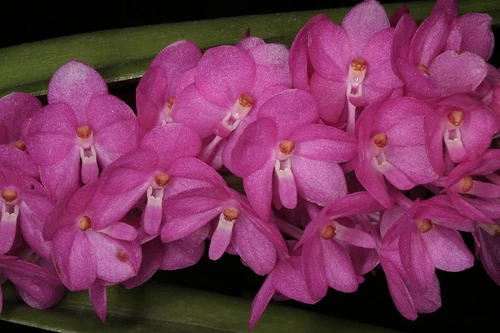
Ascocentrum ampullaceum is an species in the genusAscocentrum.


Plant blooms from spring to summer with many 2.5 cm wide flowers.


Distribution

Plants are found growing on trees in the forest of central China, Assam India, Bangladesh, the Himalayas, Nepal, Bhutan, Sikkim, Andaman Islands, Myanmar, Thailand, Laos and Vietnam at elevations of 300 to 900 meters

Culture

Plants are best grown hanged in baskets and on mounted and require bright to full sunlight and intermediate to warm temperatures. If hunged the roots must be watered frequently. Slightly reduce watering in the winter. Plants should be grown in media that is well drained such as tree fern fibers (for small plants), several pieces of coarse fir bark, or sphagnum moss.

VaritiesEdit

ImageNameDescription
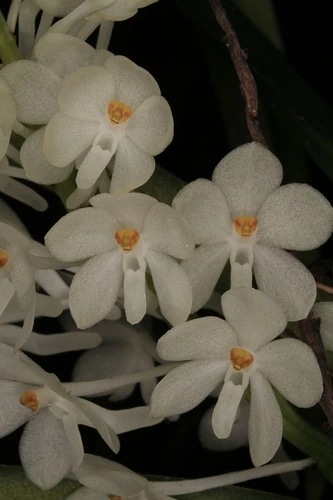
Ascocentrum ampullaceum albumAscocentrum ampullaceum var. albumsepal and petals are white.
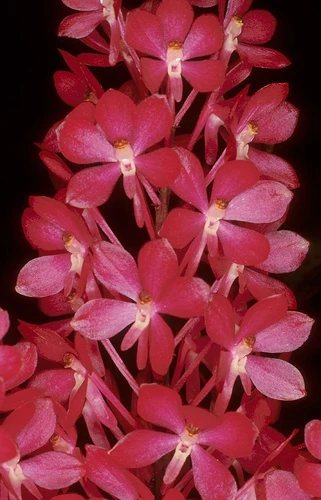
Ascocentrum ampullaceum moulmeinenseAscocentrum ampullaceum var. moulmeinensesepal and petals are red.


CITIES category : Appendix II

References :
1. Ref 1

Arundina graminifolia

Bamboo orchid
Arundina graminifolia on Kadavoor.jpg
Bamboo orchid in Kerala
Scientific classification
Kingdom:Plantae
(unranked):Angiosperms
(unranked):Monocots
Order:Asparagales
Family:Orchidaceae
Subfamily:Epidendroideae
Tribe:Arethuseae
Subtribe:Bletiinae
Alliance:Arundina
Genus:Arundina
Rich.[1]
Species:A. graminifolia
Binomial name
Arundina graminifolia
(D.DonHochr.
The bamboo orchidArundina graminifolia, is a species of orchid and the sole accepted species of the genus Arundina. This tropicalAsiatic genus extends from IndiaSri LankaNepalThailandVietnam, the Ryukyu IslandsMalaysiaSingaporeChina to Indonesia, thePhilippines and New Guinea. It has become naturalized in RéunionFijiFrench PolynesiaMicronesia, the West IndiesCosta Rica,Panama and Hawaii.

Description

Arundina graminifolia is a terrestrial, perennial orchid with reedy stems, forming into large clumps growing to a height between 70 cm and 2 m.
The plaited linear leaves are oblong lanceolate, with a length of 9 to 19 cm and a width of 0.8 to 1.5 cm. The apex is acuminate. There are amplexicaul (clasping the stem) sheathing stipules.

Bamboo Orchid, Fraser's Hill, Malaysia

This orchid blooms in summer and autumn, showing rather open clusters of showy terminal flowers, ten at the most. They bloom in succession on the terminal racemes, which are 7 to 16 cm long. These flowers, 5 – 8 cm in diameter, are a rosy lilac and white disk with a purple lip. The bracts are wide triangular and surround the main stalk of the flower cluster. The occasional fertilized seed pods contain minute powdery seeds, and small plants often develop near the cane ends after flowering, and likely aid in propagation if allowed to reach the soil.
With only 200 of the plant to be recorded growing naturally in Singapore, the species is close to extinction there, largely caused by the destruction of its natural habitat, namely the rainforests and mangrove forests. The remaining plants, commonly called Tapah weeds, can be found in the secondary forests or at the forest fringes. It is however very common in road cuts and other disturbed areas in full sun in Sarawak, East Malaysia, where it often is the most common flowering plant to be seen along the roadsides.
CITIES category : Appendix II
References :

Friday, October 30, 2015

Apostasia wallichii

Apostasia wallichii
Apostasia wallichii.jpg
Scientific classification
Kingdom:Plantae
(unranked):Angiosperms
(unranked):Monocots
Order:Asparagales
Family:Orchidaceae
Subfamily:Apostasioideae
Genus:Apostasia
Species:A. wallichii
Binomial name
Apostasia wallichii
R.Br. 1830[1]

Apostasia alba Rolfe; A. curvata J. J. Smith; A. gracilis Rolfe; A. lucida Blume ex Siebe; A. papuana Schlechter; A. stylidioides (F. Mueller) H. G. Reichenbach; Niemeyera stylidioides F. Mueller.
Plants ca. 40 cm tall. Rhizome short; roots proplike, 1.5-2.5 mm in diam. Stem suberect or prostrate toward base, not branched, with several tubular sheaths at base; sheaths to 1 cm, several veined. Leaves many, often clustered toward base of stem; blade linear to sublinear, 10-15(-18) × 0.7-1.2 cm, apex acuminate and with an awn 2-20 mm; petiole-like base 1-4 cm. Inflorescence arising from distal leaf axils, recurved, pendulous, or suberect, racemose or with a few lateral branches, 4-7 cm, many flowered; floral bracts lanceolate, 3-4 mm. Flowers 0.7-1 cm in diam.; pedicel and ovary 13-18 mm. Sepals yellow, linear to narrowly oblong-lanceolate, 4-6 × ca. 1.2 mm, 3-5-veined, apex mucronate. Petals similar to sepals, yellow; lip similar to petals but usually slightly broader. Column lacking wings; filaments ca. 0.5 mm; anthers narrowly ovoid, 1.5-2.5 mm, base sagittate; staminode subcylindric, adnate to style for most of its length though distal ca. 0.5 mm free; style ca. 3.5 mm, extending slightly beyond anthers, apex with slightly dilated stigma. Capsule cylindric, 12-25 × 1.4-2 mm. Fl. Aug.
Tropical forests, crevices, along streams; ca. 1000 m. Hainan, SW Yunnan (Yingjiang) [Bangladesh, Cambodia, India, Indonesia, S Japan, Malaysia, Myanmar, Nepal, New Guinea, Philippines, Sri Lanka, Thailand, Vietnam; Australia].


CITIES category : Appendix II

References 
1. Ref 1

Aphyllorchis alpina


Plants 75-100 cm tall. Rhizome elongate, covered in scales. Stem erect, with many membranous sheaths 1-4 cm. Inflorescence with 10-20 widely spaced flowers; rachis 19-22 cm; floral bracts reflexed, linear to linear-lanceolate, 25-30 × 3-4 mm, conspicuously longer than pedicel and ovary. Flowers spreading ± horizontally, yellowish green; pedicel and ovary puberulent, 2-3 cm, stout. Sepals ovate-lanceolate, slightly cymbiform, 18-23 × 6-7 mm, apex acuminate-caudate. Petals 14-17 × 5-7 mm; lip 14-17 mm, contracted at or above middle into epichile and hypochile; hypochile winged, basal margins forming a small sac; epichile ovate, margin often involute, apex acute. Column slightly arcuate, 1-1.3 cm. Capsule elliptic, ca. 3 × 1 cm. Fl. Jul, fr. Sep.
Forests, riverbanks; 2100-2600 m. SE Xizang [India, Nepal].
Aphyllorchis alpina
Systematics
DomainEukaryotes
Eukaryotic
KingdomPlants
Plantae
DivisionVascular plants
Tracheophyta
ClassMonocot flowering plants
Liliopsida
OrderAsparagales
Asparagales
FamilyOrchids
Orchidaceae
GenusAphyllorchis
SpeciesAphyllorchis alpina
Scientific name
§aphyllorchis alpina

CITIES category : Appendix II

References 
1. Ref 1

Anthogonium gracile

Anthogonium
筒瓣兰 tong ban lan
Anthogonium gracile IconesPlantarumAsiaticarum.png
Anthogonium gracile
Illustration in:
W. Griffith & J. McClelland:
Icones Plantarum Asiaticarum, 1851
Scientific classification
Kingdom:Plantae
(unranked):Angiosperms
(unranked):Monocots
Order:Asparagales
Family:Orchidaceae
Subfamily:Epidendroideae
Tribe:Arethuseae
Subtribe:Bletiinae
Genus:Anthogonium
Wall. ex Lindl. (1836)
Binomial name
Anthogonium gracile
Wall. ex Lindl. (1836)
Plants to 55 cm tall. Pseudobulbs usually partly buried in soil, 1-2 cm in diameter, with 2 or 3 nodes, with 2-5 leaves. Leaf blade narrowly elliptic or narrowly lanceolate, 7-45 cm long, 1-3 cm wide, papery, base petiolate, apex acuminate; petioles and sheaths forming a slender pseudostem. Inflorescence erect; peduncle slender, glabrous, with several tubular sheaths; rachis 4-20 cm, laxly 4-8-flowered; floral bracts ovate-lanceolate, small, ca. 4 mm, acute. Flowers often slightly nodding, lip rose-pink or white and tinged with red; pedicel and ovary 1.5-2 cm. Sepals connate in basal half forming a tube 7-8 mm, with apical half free; dorsal sepal oblong-lanceolate, ca. 16 mm long, 2 mm wide, obtuse; lateral sepals falcate-spatulate, ca. 16 mm long, 4.5 mm wide, acute. Petals narrowly oblong-spatulate, ca. 16 mm long, 2 mm wide, obtuse; lip ca. 1.6 cm, cuneate-clawed at base, apical part 3-lobed; lateral lobes ovate-triangular, obtuse; mid-lobe subovate, nearly as large as lateral lobes, obtuse. Column ca. 1.6 cm.

CITIES category : Appendix II
References
1. Ref 1